Twelve or sixteen
16 season color analysis: twelve versus sixteen
Sixteen-season labels come from several systems. Find where your label sits in the twelve, then test them with clothes you already own.
Sixteen-season color analysis is not one system. As of September 2026, several published systems disagree, and most sixteen-season labels sit between two of the twelve you can already look up.
That means your label needs its system name beside it. Deep Summer in one method may answer a narrow border question. Winter in another sixteen-palette method may cover a much wider range.
Is sixteen-season color analysis one system?
No. Sixteen-season color analysis is a family of systems that use the same count in different ways.
Style with DC compares five versions as of September 2026. Its own version adds in-between seasons to the familiar twelve. The Tonal version it describes uses four labels for people whose warmth looks balanced.
Karen Brunger's International Image Institute takes another route. As of September 2026, its color analysis page offers systems with 10, 16 and 23 palettes. The same page says its sixteen contains four home seasons plus twelve sub-seasons.
So Brunger's Winter is broader than any single Winter in a twelve-season system. On this site's naming, her Cool Winter lines up with True Winter. Her plain Winter remains the larger home group.
This is why sixteen does not always mean a finer version of twelve. Some methods add border labels. Brunger keeps the broad home labels and places the twelve more specific groups beside them.
Where did four seasons and twelve seasons come from?
Carole Jackson's 1980 book had four; later systems used twelve, with many current analysts tracing their work through Kalisz's Sci\ART. The available history does not support naming one person as the first to make the twelve.
Suzanne Caygill's 1980 work already used sub-groups within each season. Jackson's book still presented four. Kathryn Kalisz then launched Sci\ART as a twelve-tone system in 2000, as Chromology's account of the method explains.
You may see Sci\ART placed in the sixteen-season family. The Style with DC comparison does that as of September 2026. Yet analysts trained in Sci\ART describe twelve, and Chrysalis Colour says Kalisz chose twelve on purpose because too many groups weakened what made each group distinct.
Names also change between twelve-season methods. As of September 2026, Truth is Beauty explains that one method may say Warm Autumn where another says True Autumn. The label changed, but the broad color idea stayed close.
What do the twelve seasons add?
The twelve use three axes to narrow a home season. The first axis is warmth. The second is depth, and chroma tells whether your coloring looks bright or soft.
What makes two colors different?
Start with these simple comparisons. A color can be warm or cool, light or dark, and bright or soft.
Warm or cool
Terracotta has an orange feel. Steel Blue has a blue feel.
Light or dark
Icy Blue is much lighter than Indigo Night.
Bright or soft
Cobalt is a strong blue. Steel Blue looks more gray.
These axes explain why two people in Winter may need different palettes. One may need deeper color. Another may need clearer color. A third may sit close to Summer because her overall coloring is softer.
The color analysis hub explains the wider topic. If warmth is the hard part, read what color analysis measures and the guide to warm versus cool skin tone. The twelve seasons overview shows how the full set fits together.
This site uses the twelve. The free color analysis asks five questions, and the result names your season with the three things that decided it: warm or cool, light or deep, bright or soft.
Why do some color systems say sixteen?
They say sixteen because they are answering different border questions. One method may name a person between two home seasons. Another may keep all four home seasons as useful groups beside narrower sub-seasons.
As of September 2026, Style with DC's own system adds Soft Winter and Deep Summer between the cool seasons. It also adds Light Autumn between warm seasons. Soft Spring is described only as a bridge between Spring and Autumn, so the page does not publish a precise pair of the twelve for that label.
The Tonal version in the same comparison asks what to do when warmth is balanced. True Soft crosses the soft border between Summer and Autumn. The other Tonal labels cross the matching light border or deep border, while True Bright crosses the bright border.
Brunger's sixteen answers a different question. It lets someone remain in a broad home season or move into one of twelve sub-seasons. In the names used here, her Muted Summer matches Soft Summer, and Cool Summer matches True Summer.
Where does a sixteen-season label fit in the twelve?
Most in-between labels point to two nearby seasons. The deciding clue may be warmth or hair darkness. Light Winter points to three, and the bright-or-softer answer comes first.
| Sixteen-season label | Where it comes from | Where it sits in the twelve | What decides it here |
|---|---|---|---|
| Soft Winter | Style with DC's in-betweens | True Winter and True Summer | Hair darkness |
| Deep Summer | Style with DC's in-betweens | True Summer and True Winter | Hair darkness |
| Light Autumn | Style with DC's in-betweens | True Autumn and True Spring | Hair or eye color |
| True Soft | The Tonal version | Soft Summer and Soft Autumn | The metal question |
| True Light | The Tonal version | Light Spring and Light Summer | The metal question |
| True Bright | The Tonal version | Bright Winter and Bright Spring | The metal question |
| True Deep | The Tonal version | Deep Winter and Deep Autumn | The metal question |
| Light Winter | Tinted Winter in the 4x4 version; one sixteen-type analyst also calls it Light Winter | Light Summer, or Bright Winter or True Winter | The bright-or-softer question, then eyes or contrast |
The table is a translation, not a claim that one method replaces another. If you were typed in person, keep the analyst's system name with your label. That detail tells you what the label was meant to settle.
Soft Winter and Deep Summer sit on this border.
Both sides are cool, so warmth does not split them. True Summer holds softer color, and True Winter holds clearer, darker color.
True Summer
True Winter
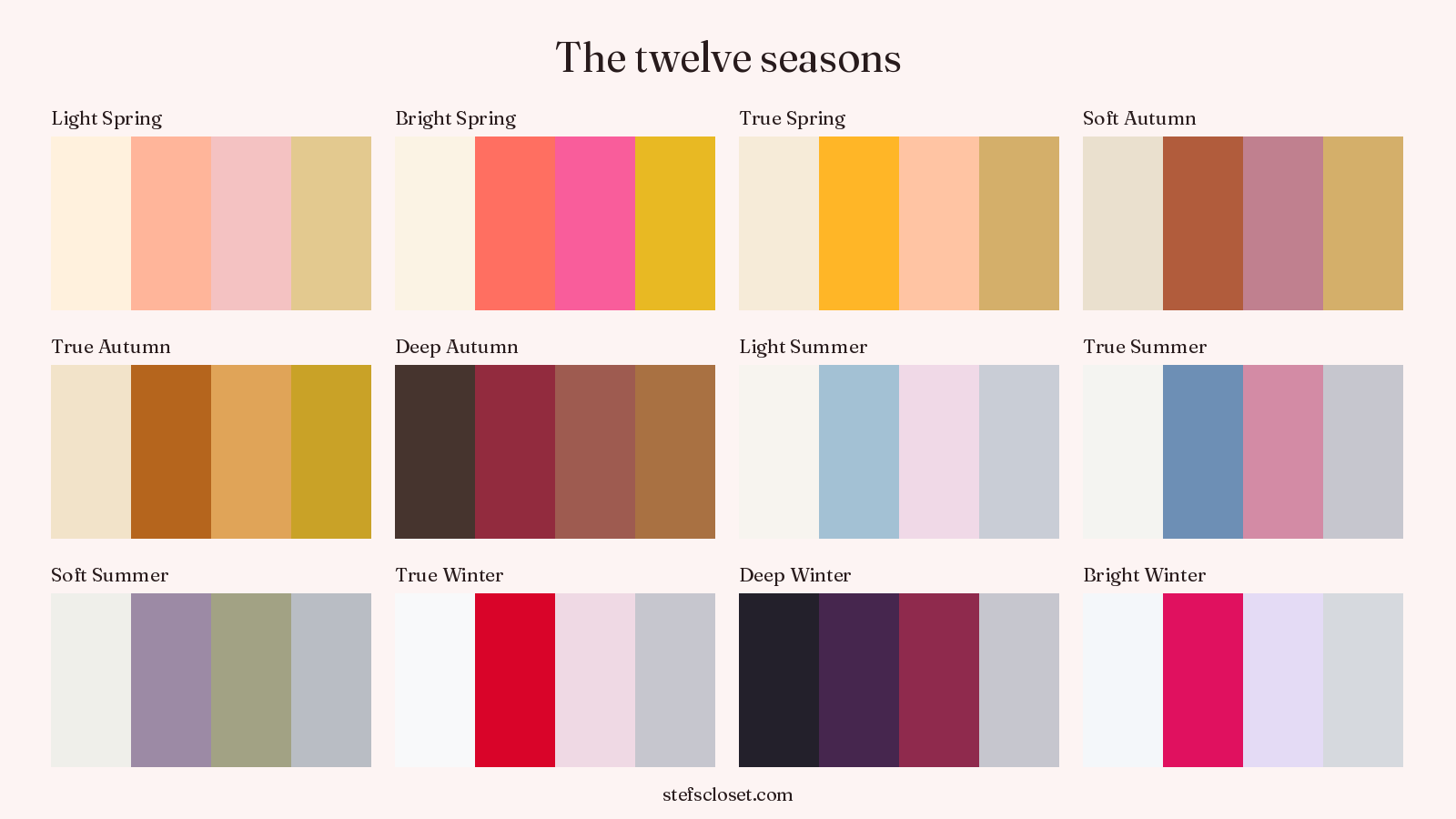
Colors from the Stef's Closet season palettes. Compare actual fabrics in daylight to see which ones you like near your face.
A Light Autumn label from Style with DC points to a warm border. A Light Autumn label from an unnamed method may not use the same definition. Check the source before buying a palette under that name.
The two seasons on the cool border.
Soft Winter and Deep Summer both land between these two. Look at how dark the hair reads against the skin, then at how clear or gray the whole face looks.

Cool color, held a little clearer.
- Cool ash-brown hair and smoky gray-green eyes.
- Her hair sits a step darker than her skin.
True Summer stays cool and keeps more color. Try French Blue and Raspberry Rose.

Cool color comes first.
- Dark, ash-toned hair and cool gray-blue eyes.
- Her hair is much darker than her skin.
True Winter puts coolness first. Try Sapphire and Icy Blue beside your face.
These are example color patterns. A season includes many skin tones and eye colors. You do not need to look like the example. Hair and eyes give clues; compare fabrics near your face before choosing a season.
Is Kibbe the same as color analysis?
No. Kibbe is a style system about lines and shapes, while color analysis is about color.
Vogue describes Kibbe, as of September 2026, as David Kibbe's system from his 1987 book. Its guidance covers silhouette and fabric. A Kibbe type can sit beside a color season because each answers a different question about getting dressed.
What should you do with a sixteen-season label tomorrow?
Open the season pages the table lists beside your sixteen-season label. You can test the border without paying for another analysis.
Same light. Same spot. Change the fabric.
Face a window with soft daylight. Compare one fabric at a time, keeping everything else the same.
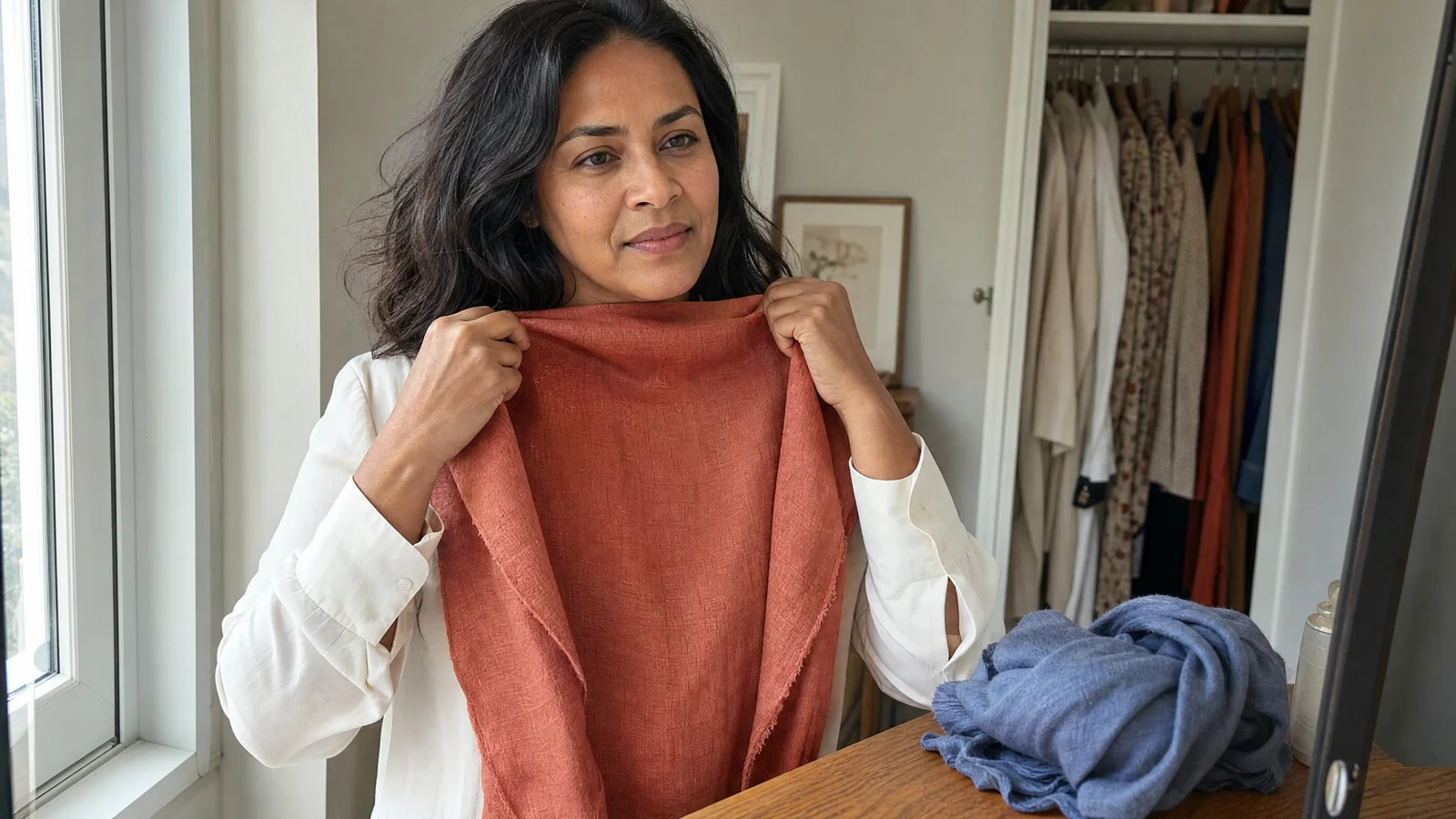
Avoid direct sun and colored lamps.Look at your face.
Keep the mirror and your position still.Swap one thing.
Try the next fabric in the same place.
Choose one color from each page that you can find at home. Hold the first near your face in daylight, then hold the second in the same place. Keep the light and your distance from the mirror the same.
Look at your face rather than the garment. Check whether shadows seem stronger and whether your skin looks even. If one test is unclear, repeat it with another color from each page.
Keep the color from the season page that looks better beside your face.
Open the full palette reference
A few more answers
Is sixteen-season color analysis one system?
No. Sixteen-season color analysis is a family of systems that use the same count in different ways.
Is Kibbe the same as color analysis?
No. Kibbe is a style system about lines and shapes, while color analysis is about color.
What should you do with a sixteen-season label tomorrow?
Open the season pages the table lists beside your sixteen-season label. You can test the border without paying for another analysis.